Face ID makes it easy to unlock your iPhone, sign in to apps, and confirm payments without entering your passcode every time.
However, some iPhone 18 Pro users may face problems after installing an iOS 27 update. Because the iPhone 18 Pro uses a new under-display sensor, software glitches or calibration bugs can cause Face ID to stop recognizing your face, fail during setup, or show a “Face ID Is Not Available” message.
If you are dealing with this issue, this guide explains why it happens and how to fix iPhone 18 Pro Face ID failing after an iOS update using simple, step-by-step solutions.
Why iPhone 18 Pro Face ID Stops Working After an iOS Update
Face ID may stop working after an iOS update for several reasons. Sometimes the problem is caused by temporary software glitches, while other times it happens due to sensor interference or changed settings.
Here are the most common reasons:
- iOS Update Bugs: A newly installed iOS update may contain software bugs or calibration glitches that prevent Face ID from recognising your face properly.
- Blocked Under-Display Sensor: Dust, smudges, or a thick screen protector covering the top-left corner of the iPhone 18 Pro screen can stop the sensor from scanning your face accurately.
- Changed Face ID Settings: Face ID may stop working for unlocking or specific apps if certain toggles or Screen Time permissions were reset during the update.
- Corrupted Face ID Data: Saved facial scan data can occasionally become outdated or corrupted after a system update, causing recognition or setup failures.
- Temporary System Glitches: Background processes that freeze right after an update can temporarily disable biometric authentication until the iPhone is restarted.
- Hardware Issues: If the TrueDepth sensor was damaged by a drop or liquid exposure, your iPhone may fail to complete Face ID setup or show a hardware alert.
- Screen Time Restrictions: Enabled Content & Privacy Restrictions can lock your Face ID settings and prevent the feature from working properly.
- Harsh Lighting or Steep Angles: Bright light behind your head or looking at the screen off-angle can interfere with the under-display sensor’s eye detection.
How to Fix iPhone 18 Pro Face ID Failing After iOS Update
If Face ID suddenly stops working on your iPhone 18 Pro after an iOS 27 update, you are not alone. Because the iPhone 18 Pro uses an under-display sensor, software glitches, recalibration bugs, or screen protector interference can sometimes stop it from recognizing your face.
Try the following fixes one by one to get Face ID working again.
Fix 1: Update Your iPhone to the Latest iOS Version (and Re-Scan Afterward)
Sometimes, an iOS update can cause bugs that affect Face ID. Apple may release another update with bug fixes and improvements. Installing the latest stable version can help resolve these issues.
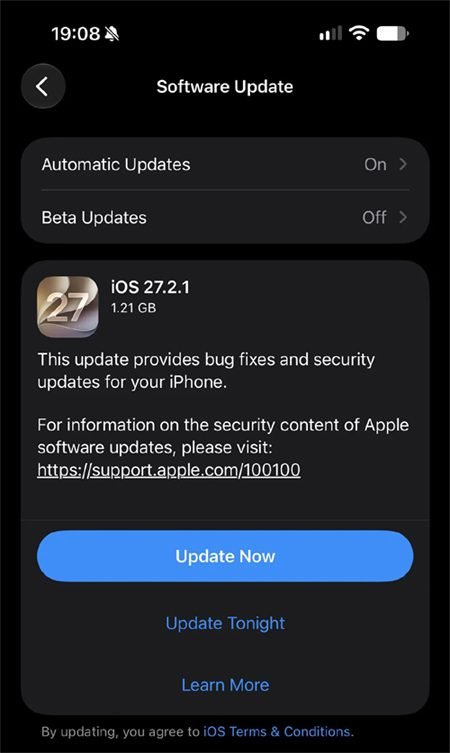
Currently, iOS 27.2.1 is the latest stable version, while iOS 27.3 is available as a beta version. A beta update is mainly for testing and may have bugs, so it is better to install the latest stable version.
Note: If you originally set up Face ID on an early iOS 27 version (such as iOS 27.0 or 27.0.1), simply updating may not fix poor recognition because your old face scan still carries the early calibration bug. After updating to iOS 27.2.1, jump to Fix 9 to reset and re-scan your face.
Steps to check for updates:
- Open Settings on your iPhone.
- Tap General.
- Select Software Update.
- Wait while your iPhone checks for available updates.
- If an update is available, tap Update Now or Download and Install.
- Follow the on-screen instructions to complete the update.
Fix 2: Check Your Face ID and App Permissions
After an iOS update, some Face ID options or app permissions may be turned off. Make sure Face ID is enabled for both system features and individual apps.
Steps to check Face ID settings:
- Open Settings on your iPhone.
- Tap Face ID & Passcode.
- Enter your iPhone Passcode.
- Check whether iPhone Unlock, iTunes & App Store, and Password AutoFill are turned on.
- Tap Other Apps and make sure Face ID is enabled for any specific apps where it stopped working.
- Turn on all the options you want to use with Face ID.
Fix 3: Clean the Under-Display TrueDepth Sensor Area
On the iPhone 18 Pro, the Face ID infrared sensor sits beneath the display near the top-left corner of the screen. If dust, fingerprints, or a thick screen protector blocks this area, your iPhone may not recognize your face properly.
Steps to clean the sensor area:
- Check the top-left corner of your iPhone’s screen.
- Use a soft, clean microfiber cloth to gently wipe the glass.
- Remove your phone case if its edges overlap the top-left corner of the display.
- Check whether a privacy, matte, or poorly aligned screen protector is interfering with the under-display sensor, and remove it temporarily to test.
- Wake your iPhone and try using Face ID again.
Fix 4: Force Restart Your iPhone
A temporary software glitch or frozen background process can affect Face ID after an update. Performing a force restart refreshes the system and clears stuck processes without deleting your data.
Steps to force restart your iPhone:
- Quickly press and release the Volume Up button.
- Quickly press and release the Volume Down button.
- Press and hold the Side button until the Apple logo appears on the screen, then release it.
- Enter your passcode manually on the first unlock, then check whether Face ID is working.
Fix 5: Check Lighting, Grip, and Face Visibility
Because the iPhone 18 Pro’s sensor sits beneath the screen, it is more sensitive to strong backlighting and hand placement than older models. Following Apple’s official Face ID guidelines, make sure nothing is blocking the sensor or washing out the infrared scan.
Steps to check:
- Remove anything covering your face, such as a mask or dark sunglasses.
- Watch your grip in landscape mode: When holding your iPhone sideways, make sure your finger or palm is not resting over the top-left corner of the screen.
- Avoid extreme backlighting: Move away from bright sunlight or strong overhead lights directly behind your head, which can interfere with the under-display sensor.
- Hold your iPhone within a comfortable distance (about 10–20 inches) in front of your face and look directly toward the screen.
Fix 6: Check Face ID with a Mask and Attention Settings
If Face ID does not recognize your face while wearing a mask, glasses, or looking slightly off-angle, adjusting the attention and mask settings can stop the sensor from misfiring after an update.
Steps to check Mask and Attention settings:
- Open Settings on your iPhone.
- Tap Face ID & Passcode and enter your passcode.
- Turn on Face ID with a Mask if you often wear a mask, then follow the on-screen instructions to set it up.
- Toggle off Require Attention for Face ID if your iPhone struggles to recognize your eyes.
- Scroll down and toggle off Attention Aware Features as well if Face ID continues to fail at slight angles.
Fix 7: Add an Alternate Appearance (or Double-Scan Your Face)
If your appearance changes because of glasses, facial hair, or makeup—or if the under-display sensor struggles in dim rooms—adding an alternate appearance gives your iPhone extra reference data.
Steps to add an alternate appearance:
- Open Settings on your iPhone.
- Tap Face ID & Passcode.
- Enter your Passcode.
- Select Set Up an Alternate Appearance.
- Follow the on-screen instructions to scan your face with glasses, or scan your exact same face a second time in dimmer lighting to improve accuracy.
Fix 8: Check Screen Time Restrictions
Sometimes, Screen Time settings can stop you from changing Face ID or passcode settings. If the Face ID & Passcode option is greyed out or missing, check these restrictions.
Steps to check Screen Time settings:
- Open Settings on your iPhone.
- Tap Screen Time.
- Select Content & Privacy Restrictions.
- Scroll down to Passcode & Face ID Changes and make sure it is set to Allow.
Fix 9: Reset Face ID and Set It Up Again
If Face ID still does not work, your saved face data may have become corrupted or retained an early calibration bug during the update. Resetting Face ID and setting it up fresh after updating iOS often solves the issue.
Steps to reset Face ID:
- Open Settings on your iPhone.
- Tap Face ID & Passcode.
- Enter your passcode.
- Tap Reset Face ID.
- Select Set Up Face ID.
- Follow the instructions to scan your face again.
- Once the setup is complete, check whether Face ID works.
Fix 10: Reset All Settings
If Face ID still does not work, a conflict in your system configuration may be causing it. Resetting all settings can help fix this issue without deleting your photos, apps, or personal files.
Note: This will reset saved Wi-Fi passwords, wallpapers, and other system settings.
Steps to Reset All Settings:
- Open Settings on your iPhone.
- Tap General.
- Scroll down and select Transfer or Reset iPhone.
- Tap Reset and choose Reset All Settings.
- Enter your passcode to confirm. After your iPhone restarts, set up Face ID again.
Fix 11: Reinstall iOS via Recovery Mode (Skip Face ID During Setup)
Some iPhone 18 Pro users and Apple Support technicians have found that a software bug occurs when Face ID is configured during the initial “Hello” setup screen right after a major update. Reinstalling iOS cleanly and setting up Face ID inside Settings afterward can bypass this bug.
Note: Back up your iPhone to iCloud or a computer first before using Recovery Mode.
Steps to reinstall iOS cleanly:
- Connect your iPhone 18 Pro to a Mac (using Finder) or Windows PC (using the Apple Devices app) with a USB-C cable.
- Quickly press and release Volume Up, then quickly press and release Volume Down.
- Press and hold the Side button until you see the Recovery Mode screen (a cable pointing to a computer).
- On your computer, select Update (do not choose Restore unless you want to erase your data) to reinstall iOS.
- When your iPhone reboots to the setup screens, tap Set Up Later when prompted for Face ID.
- Once you reach the Home Screen, open Settings > Face ID & Passcode and set up Face ID from there.
Fix 12: Run Apple’s Built-In Face ID Diagnostic Mode
If Face ID still does not work or you see a “Face ID Is Not Available” message, you can use Apple’s built-in diagnostic mode to check if the TrueDepth sensor has a hardware problem.
Steps to run diagnostics:
- Turn off your iPhone completely.
- Press and hold both the Volume Up and Volume Down buttons at the same time.
- While holding both buttons, connect your iPhone to a charger or computer using a USB-C cable.
- Release the buttons once the Apple logo appears on the screen.
- Select Run Diagnostic and choose the Face ID/TrueDepth test to check for hardware issues.
Contact Apple Support
If none of the above fixes work, there may be a problem with the TrueDepth sensor or another hardware component. In this case, contact Apple Support or visit an authorized Apple service provider to get your iPhone checked. Avoid trying to repair the under-display camera system yourself, as doing so can permanently disable Face ID and void your warranty.
Tips to Avoid Face ID Problems in the Future
Here are a few simple habits that can help prevent Face ID issues on your iPhone 18 Pro later on:
- Keep iOS updated: Install the latest stable iOS updates regularly to receive biometric bug fixes and security improvements.
- Stick to stable iOS releases: Avoid installing beta software on your primary iPhone, as early test builds often trigger temporary Face ID bugs.
- Choose a clear screen protector: Avoid thick privacy or matte films that can scatter the infrared light passing through the under-display sensor.
- Wipe the top-left screen area: Clean the upper-left corner of your display regularly with a soft microfiber cloth to prevent smudges and oil buildup.
- Protect your screen from drops: Use a reliable protective case with raised edges to prevent impact damage to the under-display TrueDepth hardware.
- Set up an alternate appearance: Add a second face scan if you regularly switch between glasses, sunglasses, or different hairstyles.
- Mind your grip in landscape mode: Keep your fingers away from the top-left corner of the display when holding your phone sideways so you don’t accidentally block the sensor.
Conclusion
Face ID problems after an iOS update can be irritating, especially when you rely on it every day to unlock your phone and access apps.
However, checking your settings, cleaning the under-display sensor area, force restarting your device, and resetting Face ID usually resolve the issue.
If you are still searching for how to fix iPhone 18 Pro Face ID failing after an iOS update, work through the fixes in this guide one by one. If none of the software steps work, contact Apple Support to check for a possible hardware problem.
FAQs
Why is Face ID not working after an iOS update?
Face ID may stop working because of iOS update bugs, changed settings, a blocked under-display sensor, or a temporary system glitch.
Why does my iPhone 18 Pro restart when Face ID fails?
An early iOS 27 bug caused a system crash and unexpected reboot whenever Face ID failed to authenticate in apps like Wallet. Updating your iPhone to iOS 27.2.1 or newer permanently fixes this reboot glitch.
Can an iOS update fix Face ID problems?
Yes. If the problem is caused by an iOS bug, installing a newer stable update (such as iOS 27.2.1 or later) often includes a permanent fix.
Can a screen protector stop Face ID from working on the iPhone 18 Pro?
Yes. Because the iPhone 18 Pro places the infrared sensor beneath the display in the top-left corner, thick tempered glass, matte films, or privacy screen protectors can block or scatter the scan. Switching to a clear, standard-thickness screen protector usually resolves this.
Why does Face ID work for unlocking but not for apps?
Some apps may not have permission to use Face ID after an update. Open Settings > Face ID & Passcode > Other Apps and make sure the toggles for those apps are turned on.
Why is the “Face ID & Passcode” option missing from Settings?
If the Face ID & Passcode menu is greyed out or missing, Screen Time restrictions are likely blocking changes. Go to Settings > Screen Time > Content & Privacy Restrictions > Passcode & Face ID Changes and set it to Allow.
Will resetting Face ID delete my data?
No. Resetting Face ID only removes your saved facial scan data. It does not delete your photos, apps, contacts, or other personal files.
What should I do if Face ID still does not work after resetting it?
If Face ID still fails after resetting and setting it up again, try Reset All Settings or run Apple’s Diagnostic Mode to test the sensor. If the issue persists, contact Apple Support for a hardware inspection.
Further Readings
- iPhone 18 Pro & Pro Max Vertical Lines: Troubleshooting Steps and Repair Options
- How To Stop iPhone & Mac From Automatically Showing Subtitles (iOS 27)
- How To Fix iPhone Timer Not Making Sound

Danny Paul is a tech specialist and avid gamer with over 10+ years of experience resolving complex system errors, software bugs, and platform glitches. He specializes in creating straightforward, actionable troubleshooting guides for Android, iOS, PC gaming, and mainstream social media networks to help users fix issues instantly. In his free time, he loves solving puzzles, playing online games, watching movies, and traveling.